

Understanding and measuring pressure have become essential in many industries. Have you ever wondered how engineers measure the level of fluid in deep tanks or wells? The answer lies in the smart device known as a submersible pressure transmitter. But the question arises: What is a submersible pressure transmitter, and how does it work?
Grasping this concept helps you improve efficiency and automation in fluid management systems. It also lets you monitor liquid levels in water bodies in real-time, without the need for manual checks. If you are new to this terminology, worry not! This detailed guide will help you understand it easily and comprehensively. So, let’s begin!
What is a Submersible Pressure Transmitter?
Let’s first understand what a submersible pressure transmitter is!
A submersible pressure transmitter is a special sensor designed to measure the pressure of liquids. It is shaped like a long, thin tube, which is fully waterproof. You simply lower it into the tank. After which, it starts measuring how much pressure the liquid is putting on it. Its other name is a submersible pressure transducer.
This pressure is used to figure out how deep the sensor is. So, it also helps measure the level or depth of the liquid. The deeper it goes into the liquid, the more pressure it feels. This pressure increases with depth. So by measuring it, the device can also tell how much liquid is above it. That’s why this device is also known as a liquid level sensor.
Submersible pressure transducers have wide usability. They are used in water treatment plants, irrigation systems, oil tanks, and underground wells. Besides, their reliability and accuracy don’t require much maintenance. They are specially made for use in underground systems. Hence, they are made with robust materials like stainless steel or titanium, which prevent rust or damage.
Components of a Submersible Pressure Transmitter
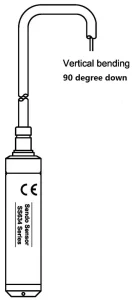
I hope you got the basics of the submersible pressure transducer. Right? However, before we proceed to the detailed working of this device, let’s discuss its components.
- Pressure Sensing Element: It is the central part that actually feels the pressure of the liquid. It usually looks like a tiny, flexible membrane or diaphragm. When the sensor is placed underwater, the liquid pushes against this diaphragm.
- Electronic Circuit: This part is inside the sensor that detects pressure changes. After that, it converts that movement into electrical signals. When the diaphragm feels pressure and bends, this part measures that change. Then, it turns that change into a signal.
- Cable: It is a strong, waterproof wire that connects the sensor to the monitoring system. It has two main jobs. First, it sends power to the sensor so it can work. Second, it carries the electrical signal from the sensor to a display or control system.
- Protective Housing: It is the outer shell of the submersible pressure transmitter. It protects the pressure-sensing element, electronic circuit, and cable from water damage. Therefore, it is usually made with robust materials like stainless steel or titanium.
How Does a Submersible Pressure Transmitter Work?

Understanding the parts of a submersible pressure transmitter was just the beginning. Curious to know what happens after the sensor is dropped into a tank or well? Let’s find the answer in the detailed working of the submersible pressure transducer.
Step 1: Submersion
The first step in the working process of a submersible pressure transmitter is submersion. This step is all about placing the device directly into the liquid you want to measure. This liquid could be clean water, wastewater, oil, chemicals, or any other fluid. However, during this step, when you submerge the device, hang it by its cable.
Also, make sure that the device is fully underwater and placed at the right depth. It’s essential that the sensor sits still and isn’t floating or moving too much. For this purpose, some setups use a small weight at the bottom of the sensor to help keep it steady. So if the submersion is not done correctly, you will not get the accurate results.
Step 2: Pressure Sensing
After submersion, the submersible pressure transmitter starts sensing the pressure. HOW? Actually, the liquid around the sensor begins to press against the sensor’s diaphragm. The deeper the sensor is placed, the more liquid is above it. As a result, the greater the pressure it feels. This pressure comes from the weight of the liquid pushing down on the sensor.
The diaphragm in the sensor is very sensitive. It moves a little with even small pressure changes. As the diaphragm moves, the internal piezoresistive pressure sensor detects this movement. These movements are tiny, but they are enough for the sensor’s electronics to detect. The sensor prepares to turn the pressure reading into an electrical signal.
Step 3: Signal Conversion
After the sensor detects the pressure from the liquid, the next step is signal conversion. These are the electrical signals that the machines or monitoring systems can understand. Inside the submersible pressure transmitter, a special type of sensing technology is often used. This is a piezoresistive pressure transducer.
This type of sensor works by changing its electrical resistance when pressure is applied to it. The pressure causes tiny changes in the sensor’s internal material. Those changes are then converted into an electrical signal. This signal is usually sent in standard formats like 4–20 mA. These signals can travel through the waterproof cable and move to the control system.
Step 4: Data Transmission
Once the pressure has been converted into an electrical signal, the next step is data transmission. This means the signal now travels from the sensor to an external device, such as a digital display. Through this panel, you can see and use the information. Remember, the electrical signals are sent through a waterproof cable.
However, depending on the type of signals being used, like 4–20 mA or 0–10V, the signal can be received and read in different ways. For example, in the case of a tank, these signals might go to the screen and show the entire level of the tank. But in advanced systems, these signals are sent to a PLC (Programmable Logic Controller). It automatically controls valves based on the liquid level.
Step 5: Pressure to Level Conversion
In this final step, the measured pressure is converted into the liquid level. As I said above, the pressure increases with the depth of the liquid. The sensor can calculate its depth of submersion. The deeper the sensor, the higher the pressure. This directly tells us the level of liquid. The industrial pressure transducer plays a key role here for several industries.
However, the conversion is often handled by a controller, display unit, or software system. They take the pressure data and translate it into height or depth units, such as meters. So, even though the sensor measures pressure, you can also see that the final output is the actual level of the liquid.
Types of Output Signals
As I said above, submersible pressure transmitters send pressure data in the form of signals. Actually, these signals are a type of language that talks to the control systems or displays. Therefore, choosing the right output signal is essential. It affects how accurate, reliable, and easy-to-read your data will be. Here are three common output signal types.
- Analog Signals: These are continuous signals. This means the value changes smoothly as the pressure changes. Typical examples are 4-20 mA current and 0-5V or 0-10V voltage signals. Among those, a submersible pressure transducer 4 20mA popular for industrial settings. The reason is that these signals can travel long distances.
- Digital Signals: These send pressure readings in digital format, like numbers. Those numbers can be read by computers or programmable logic controllers (PLCs). Their examples are RS-485 and Modbus. These signals are suitable for the situation where very precise data is required.
- Frequency Signals: These types of signals are not in the form of voltage or current. Instead, the submersible pressure transmitter sends a signal in pulse form. However, the frequency (how fast the pulses come) changes depending on the pressure. This is the least common type of output signal.
Installation Tips For Submersible Pressure Transmitter
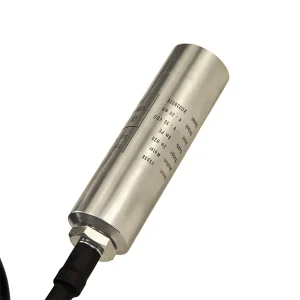
To ensure your submersible pressure transmitter gives accurate readings, proper installation is key. So, before you power it up, here are some essential installation tips you must follow.
- Use a Protective Weight: While installing the submersible transmitter, it must stay in one place. Therefore, you must use a protective weight. It is usually attached to the sensor or its cable to help keep it steady at the bottom.
- Avoid Turbulence: The swirling or splashing of water is called turbulence. However, when installing a submersible pressure transmitter, it is vital to place it in calm water. The turbulence can cause the sensor to give an incorrect reading. So to avoid this, you should install a transmitter away from pumps or waterfalls.
- Protect the Cable: The cable connected to a submersible pressure transmitter is very important. It carries electrical signals and power. If the cable gets bent or cut, the device might stop working or give wrong readings. So to keep the cable safe, avoid sharp bends. Also, don’t rub it against the rough surface and use a cable clamp to hold it secure.
- Check for Air Bubbles: Air bubbles trapped around the sensor can affect the accuracy. The reason is that a submersible pressure transducer only measures the liquid pressure. If a bubble covers the sensor, it might give low readings. So always lower the transmitter gently into the liquid and slightly shake if a bubble is present.
- Watch for Sediment: Sediment, such as sand, dirt, or mud, can collect around the sensor. This buildup can block the sensor or change the pressure readings. To prevent this, install the submersible pressure transmitter slightly above the bottom. You can also use a protective cover or filter to keep sediment away.
Frequently Asked Questions
How deep can a submersible pressure transmitter go?
The depth a submersible pressure transmitter can reach depends on its design and model. Most standard transmitters can measure depths from a few meters up to around 200–300 meters. However, there are some specialized models built for even deeper measurements, going over 1000 meters.
Is it safe to use a submersible pressure transducer in drinking water?
Yes, it is safe to use a submersible pressure transducer in drinking water. However, this is only the case if the device is specifically designed for drinking water applications. These models are made with non-toxic materials such as food-grade plastic or stainless steel.
Can I use a submersible pressure transmitter in saltwater?
Yes, you can use a submersible pressure transducer in saltwater. However, saltwater can quickly damage standard materials. So, ensure the transmitter is made from marine-grade stainless steel and corrosion-resistant coatings.
Conclusion
A submersible pressure transmitter is a reliable tool for accurate pressure measurement. It works effectively even in challenging environments, such as tanks and open water. Knowing its basics and how it works helps you maintain it and install it correctly. In this article, I have discussed the basics of submersible pressure transducers and their working.
The main feature of this smart tool is sending pressure measurements as electrical signals. Those signals provide a highly accurate reading on the display. Besides measuring pressure, you can also measure the depth of a water body. This makes the submersible pressure transducer for level & pressure ideal for measurement.