

Pressure sensors have a diversity of applications in different areas. All these industries use these sensors, from automotive and HVAC to medical and consumer electronics.
However, there are a definite range of pressure sensors. A few come at a higher price and are used for comprehensive systems. However, a few are low-cost pressure sensors.
Do you want to know about low-cost pressure sensors? This guide will explore the low-cost pressure sensors with different types and applications.
What is a low-cost pressure sensor?

A low-cost pressure sensor is a compact and functional pressure measurement device. These economical devices bring the ultimate air and water pressure applications at affordable prices.
These sensors are often helpful in:
- Consumer electronics (e.g., smartwatches, drones, and smartphones)
- Automotive systems (e.g., tire pressure monitoring, fuel systems)
- HVAC (heating, ventilation, and air conditioning)
- Water systems and portable devices
How does a low-cost pressure sensor work?
The low-cost pressure sensor is the same as the other sensors. The working mechanism is the pressure conversion into electrical signals.
The steps of a low-cost pressure sensor’s working mechanisms are:
- Step 1: Pressure Application. The pressure of the medium acts on the sensor’s diaphragm. The diaphragm produces or senses the changes.
- Step 2: Deformation of Diaphragm. The diaphragm deflects proportionally to applied pressure. The amount of deflection relies on the material, pressure level, and diaphragm design.
- Step 3: Signal Conversion. There are sensing elements, such as piezoresistive, capacitive, or MEMS. This element converts pressure into an electrical signal.
- Step 4: Signal Conditioning. Signals are weak. Their amplification is essential and done by internal circuitry to produce a standardized output.
- Step 5: Output Transmission. Electrical signals come as an output. Microcontrollers, displays, or control systems give pressure reading, monitoring, or feedback control.
Types of low cost pressure sensor
Low-cost pressure sensors are a general term that includes several types. Here is the list of low-cost pressure sensors.
Piezoresistive Pressure Sensors
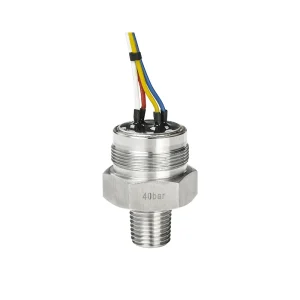
Piezoresistive Pressure Sensors rely on electrical resistance. With the mechanical pressure changes, the electrical resistance changes. It transforms into the signals, and the control system reads them into the output signals.
The standard features include:
- High sensitivity and linear response
- Inexpensive and easy to manufacture
- Suitable for low-to-medium pressure ranges
- Commonly used in automotive and consumer devices
Capacitive Pressure Sensors
Capacitance changes also help sense the pressure. The mechanical pressure can alter the capacitance and help deform the measuring diaphragm. It then provides the accurate values for the pressure changes.
The standard features of these low-cost pressure sensors include:
- Low power consumption
- High stability and repeatability
- Can measure both static and dynamic pressures
- Moderate cost and compact design
MEMS-Based Pressure Sensors
MEMS refers to the Micro-Electro-Mechanical Systems. This sensor is miniature and fabricated on a silicon wafer.
Here are the following features of such a pressure sensor.
- Ultra-compact and cost-effective
- Low power requirements
- Suitable for digital output applications
- High production efficiency
Optical Pressure Sensors
Optical Pressure Sensors are unique types that involve the wavelength changes. They detect the pressure changes based on the optical mechanisms.
Here is the list of unique features:
- Immunity to electromagnetic interference
- Suitable for environments where electrical sensing may be unsafe
- Increasingly affordable due to modern optical fabrication methods
Applications of low-cost liquid pressure sensors
Low-cost hydraulic pressure sensors have the following applications.
Automotive industry
The automotive industry involves both the liquid and air pressure changes. Therefore, low-cost pressure sensors offer the following amenities.
- Tire Pressure Monitoring Systems (TPMS) to ensure safe tire inflation.
- Fuel and oil pressure monitoring for engine optimization.
- Air conditioning systems are used to regulate compressor performance.
Consumer electronics
Consumer electronics have smartphones as a strong candidate. They have compact, low-cost pressure sensors to understand weather trends.
It is helpful in:
- Altimeters in fitness trackers
- Barometers in mobile phones
- Air pressure sensors in drones for altitude control
HVAC system
Low-cost pressure sensors are useful in other systems, such as:
- Air filter monitoring
- Duct pressure control
- Airflow measurement
HVAC systems offer optimal ventilation and reduce energy consumption.
Water and fluid systems
Water and fluid pressure can produce significant pressure. Their pressure changes assessment is necessary. Applications in domestic water and fluid systems include:
- Pump performance
- Pipe leakage detection
- Water pressure in pipelines
Medical and healthcare devices
The medical industry has several applications used for pressure changes. For example:
- Blood pressure monitors
- Ventilators
- Portable oxygen concentrators
Accurate pressure measurements allow better pressure management in medical devices.
Advantages of low-cost air pressure sensors
Low-cost differential pressure sensors offer several benefits. You can explore a range of benefits, such as:
Cost-effectiveness
Low-cost air pressure sensors are affordable and have a compact design. It decreases the deployment costs and saves the infrastructure. Therefore, it is a more affordable choice for installation and usage.
Overall benefits are:
- Enables large-scale deployment
- Reduces overall project costs
- Ideal for consumer-grade and educational applications
Compact size
Pressure sensors can be large or small. However, large-sized ones require more space and cause extra hassles. But low-cost pressure sensors have a compact size. They are:
- Suitable for wearables, drones, and compact electronics
- Lower shipping and handling costs
- Easier PCB integration
Easy integration
A wide range of applications of low-cost pressure sensors makes them an ideal choice. They are easy to integrate due to their compact size and are part of the following systems.
- Ideal for prototyping and IoT projects
- Reduces external circuit complexity
- Compatible with low-voltage systems (3.3V or 5V)
Low power consumption
Because of their compact size, they don’t consume much power. Even their power efficiency is pretty high. The prominent benefits are:
- Longer battery life in wearable devices
- Reduced energy costs in distributed sensor networks
- Suitable for remote data collection applications
Conclusion
A low-cost pressure sensor is all about the compact structure and accuracy. They come with precise pressure measurements. Compact design can make it in electronics and other applications.
Don’t worry if you want to purchase premium-quality, low-cost pressure sensors. Sendo-sensor stands out among all the brands because of its high-quality pressure sensors. Our low-cost, high-temperature pressure sensors offer a range of pressures. You also get robust construction. Check out more collections.