

Whether it is a hydraulic press or a food processing industry, all have some extent of pressure changes. Sometimes, it is the fluid running through the system. Air pressure can also play a crucial role.
Failure to manage the pressure changes can result in accidents and damages. There come the pressure sensors that are unsung heroes. They offer a wide range of features and maintain pressure changes.
These industrial pressure sensors have a wide range of applications. Today we will understand the applications of industrial pressure sensors and understand how they can work.
What is an industrial pressure sensor?

An industrial pressure sensor is a measurement device used in the industrial sector. It helps calculate the pressure of liquids and gases and provides a constant value accuracy.
An industrial pressure sensor is built differently from a traditional pressure sensor. It has the following key features:
- Stainless steel or titanium housings for corrosion resistance.
- Wide operating pressure ranges
- Temperature compensation for stability under fluctuating conditions.
- Explosion-proof or intrinsically safe designs for hazardous areas.
- Hermetically sealed electronics for protection from dust and moisture (IP65–IP69K ratings).
You can explore the following pressure measurement changes in pressure measurements.
- Gauge pressure: Pressure relative to atmospheric pressure.
- Absolute pressure: Pressure relative to a perfect vacuum.
- Differential pressure: The difference between two pressure points.
Types of an industrial pressure sensor
Industrial pressure sensors don’t come in a single form. Instead, they have many types and offer the following features.
Piezoresistive Pressure Sensors
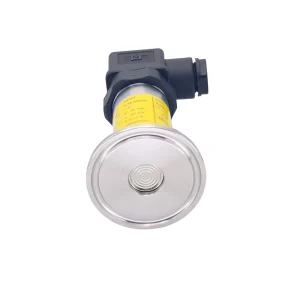
Piezoresistive Pressure Sensors detect the electrical resistance changes with the diaphragm alterations. When there is a change in the pressure, the diaphragm gets deformed. It leads to a change in electrical resistance. As a result, it gives an output on the display system.
Capacitive pressure sensors
In Capacitive pressure sensors, the pressure application is the same. Only the mechanism is different. In this type, there is a change in capacitance when the pressure is applied to the diaphragm.
Strain Gauge Pressure Sensors
Strain gauges are present in these pressure sensors. The change in the strain causes an electrical output on the display system.
Resonant and Optical sensors
The wavelength of the light changes with the pressure transmission. Optical sensors detect the change and produce a changing wavelength. This wavelength change leads to display output.
Applications of an industrial pressure sensor
Industrial pressure sensors have various applications with several benefits in each industry.
Here are a few industrial sectors and applications.
Oil and Gas industry

The oil and gas industry has to battle with extreme conditions. High temperature and pressure can impact the performance.
The applications are:
- Drilling operations. Measure downhole pressure to prevent blowouts. It also optimizes drilling depth.
- Pipeline monitoring. Detect pressure drops. It helps detect leaks or blockages to ensure a safe monitoring system.
- Refinery process control. Monitor fluid pressure in distillation, cracking, and refining units.
- Storage and transportation. Maintain safe pressure levels in tanks and pipelines.
The benefits are:
- Enhanced safety through early leak detection.
- Optimized process efficiency.
- Prevention of costly downtime and environmental hazards.
Chemical and petrochemical industry
Chemical processing is a crucial phenomenon. It is never possible without the right temperature. Therefore, you should consider an industrial pressure sensor for such an industry.
The key applications are:
- Reactor vessels. Sensors monitor pressure changes to maintain reaction equilibrium.
- Pump systems. They help prevent cavitation and make consistent fluid flow.
- Distillation columns. Measure differential pressure and control liquid levels under all conditions.
- Gas storage tanks. It detects pressure buildup and avoids hazardous releases.
The prominent benefits are:
- Accurate process control for consistent product quality.
- Compliance with safety and environmental regulations.
- Reduced equipment wear due to balanced pressure management.
Water and waste treatment industry

The purpose of the pressure sensors is to deal with fluid pressure changes. In the water and waste industry, water pressure is necessary. So, a pressure sensor helps in the following applications.
- Pump monitoring. Ensure optimal inlet/outlet pressures for energy-efficient operation.
- Filter condition monitoring. Use differential pressure sensors to detect clogged filters.
- Pipe leakage detection. Identify abnormal pressure drops in water distribution systems.
- Level measurement. Monitor tank and reservoir levels using hydrostatic pressure sensors.
The benefits of the pressure sensors include:
- Reliable water supply control.
- Early leak detection saves resources and reduces maintenance costs.
- Improved energy efficiency and system longevity.
Power generation
Power plants also involve various applications. It can be turbine monitoring or broiler systems. You should know the following applications.
- Boiler systems. Measure steam pressure to avoid dangerous overpressure conditions.
- Turbine monitoring. Maintain lubrication oil pressure for smooth operation.
- Condenser systems. Monitor vacuum levels for efficient condensation.
- Cooling systems. Ensure optimal pressure in cooling water circuits.
The prominent reason to use the pressure sensors in these systems is due to:
- Safe and efficient plant operation for efficient power generation.
- Extended turbine and boiler lifespan.
- Reduced downtime and maintenance costs.
Manufacturing and automation
In the manufacturing and automation industry, pneumatic and hydraulic systems are used. Measuring pressure is crucial to ensure smooth manufacturing.
Here are a few of the most crucial applications.
- Hydraulic presses and injection molding machines. Maintain consistent clamping pressure. And ensure better operations.
- Pneumatic actuators. Monitor air pressure for controlled motion. It also avoids any mishaps due to high-pressure changes.
- Robotic systems. Ensure correct gripping and positioning force for adequate control.
- Compressor control. Regulate air supply in industrial automation lines.
The benefits of using pressure sensors include:
- Enhanced production accuracy and repeatability.
- Reduced mechanical wear through balanced pressure control.
- Energy savings through optimized air and fluid systems.
Automotive and heavy machinery
Automotive and heavy machinery also involve pressure sensors for various options. Here is the list of features.
- Engine oil and fuel systems. Monitor pressure for performance optimization.
- Brake systems. Ensure hydraulic pressure stability for safety.
- Transmission systems. Detect pressure variations for smooth gear shifting.
- Air suspension systems. Regulate air pressure for vehicle comfort and balance.
The main benefits include:
- Improved fuel economy and reduced emissions.
- Enhanced vehicle safety and performance.
- Predictive maintenance capabilities.
Aerospace and defense
Aerospace and defense systems have more complex applications. It involves extreme altitudes and temperature changes. A harsh environment can deteriorate the sensors and may affect the calculations.
Industrial pressure sensors have robust construction and are durable. Pressure Sensor applications in industry are:
- Cabin pressurization. Maintain safe internal cabin pressure.
- Fuel systems. Monitor fuel line pressures for engine efficiency.
- Hydraulic systems. Ensure stable actuator pressure for flight control surfaces.
- Altitude and airspeed measurement. Use barometric pressure for navigation systems.
The prominent benefits include:
- Increased flight safety.
- Efficient engine and hydraulic system performance.
- Compliance with stringent aerospace standards.
Food and Beverage industry
The food and beverage industries have two main focuses. First, maintain hygiene during food processing. Second, produce the premium taste. Pressure sensors’ industrial applications allow a controlled system to offer better facilities for both taste and hygiene.
In the food and beverage industries, here are a few applications:
- Pasteurization and sterilization. Maintain correct pressure and temperature.
- Beverage filling lines. Ensure consistent product filling levels.
- Mixing and fermentation. Monitor pressure for controlled reactions.
- CIP/SIP systems. Handle high temperatures and cleaning pressures. It improves hygiene and control.
The positive points to include the pressure sensor application in industry are:
- Compliance with sanitary standards (3-A, EHEDG, FDA).
- Improved product consistency.
- Reduced downtime due to hygienic design.
Pharmaceutical industry
The pharmaceutical industry is one of the most unique industries. It features better control over hygiene and ensures safe drug manufacturing. The prominent uses of the sensors include:
- Fermentation vessels. Control pressure for microbial growth optimization and speed it up.
- Filtration systems. Monitor differential pressure for membrane efficiency.
- Autoclaves and sterilizers. Ensure correct pressure during sterilization cycles.
- Packaging lines. Maintain sterile pressure in filling systems and ensure proper packaging.
In the pharmaceutical industry, the pressure sensors allow:
- Good Manufacturing Practice compliance.
- Improved product yield and quality control.
- Enhanced sterility assurance.
HVAC and building automation
In HVAC and building automation, pressure sensors are crucial. They offer accuracy and measure the pressure changes to predict failures. The key applications include:
- Air duct pressure monitoring. Proper pressure maintains proper ventilation balance. There are fewer chances of tools overheating.
- Filter monitoring. Here, differential pressure sensors are useful. They indicate clogging of filters and help replace them.
- Refrigerant systems. Pressure for optimal cooling performance.
- Boiler and chiller systems. Prevent overpressure damage.
Why should you use industrial pressure sensors? The logic is straightforward.
- Energy-efficient operation.
- Reduced maintenance through predictive monitoring.
- Enhanced occupant comfort and system safety.
Conclusion
Industrial pressure sensors are more than pressure measurement tools. They can:
- Estimate the pressure and avoid the drastic changes
- Predict the failures in the system
- Offer a comprehensive range of pressure
- It can help measure the temperature changes as well.
Because of robust construction and affordability, they are pretty effective. However, you have to purchase the premium quality industrial pressure sensors.
Contact Sendo-sensor if you need a ride on premium industrial pressure sensors. Our industrial pressure sensor has a durable construction and offers a wide range of applications. Check out the collection to make your choice now!