

Pressure transmission is essential to handle several household tasks. From simple machinery to household heavy-duty vacuum tools, there are different systems utilizing the pressure.
There are different tools to measure the press changes and ensure the accuracy of tasks. One of the most crucial tools is the differential pressure transmitter. It is pretty useful in the detection of pressure in different environments.
We will highlight how the differential pressure transmitter works and understand various applications.
Let’s chase the quality discussion!
What is a differential pressure transmitter?
A differential pressure transmitter is a unique device in its working system. Unlike the other pressure sensors, this differential pressure transmitter measures the pressure difference between two points.
For example, you must measure the pressure difference between high and low points.
- It has two input ports: high-pressure side (HP) and low-pressure side (LP).
- The device senses the pressure difference (ΔP = P1 – P2).
Once you have made a difference, the whole task will be simple. You can convert it into an electrical signal that controllers or data systems can monitor.
Because of the pressure difference detection, the differential pressure transmitter is ideal for several applications.
How does a differential pressure transmitter work?
Differential Pressure Sensors aim to detect the pressure between the two points. Here is how this system works.
- Step 1: Pressure Inlets. The pressure sensor has a dual connection with the system. One is at a higher pressure and the other at a lower pressure.
- Step 2: Sensing Element. A diaphragm or piezoresistive sensor element is there to help find the accurate pressure changes and bend under the force of the pressure difference.
- Step 3: Signal Conversion. This mechanical deflection is converted into an electronic signal.
- Step 4: Output. The transmitter outputs the data as a 4–20 mA current, voltage, or digital signal to a monitoring system.
The final output is translated into digital signals and helps interpret the driven results.
7 Differential Pressure Sensor Applications
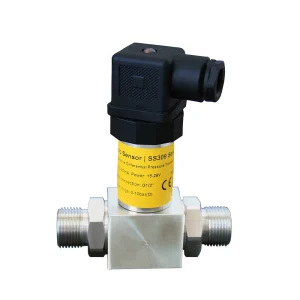
Differential Pressure Sensors have a few key applications and use cases, which are discussed below.
HVAC system
In heating and HVAC systems, differential pressure transducers are highly effective for the following purposes.
- Airflow Monitoring helps detect the air pressure and ensures that ducts deliver the right air.
- Filter Monitoring can spot the clogged filters and understand the need for replacement.
- Energy Efficiency optimizes fan and motor operation for cost savings.
Without the pressure sensors, it is challenging to optimize the system, and overheating might occur.
Oil and Gas industry
The oil and gas industry is also a prominent application for the differential pressure transmitters. They are used for the following purposes.
- Flow Measurement. They calculate flow in pipelines using orifice plates or venturi tubes.
- Pump Monitoring helps measure pressure and ensure optimal pressure inside the pumps.
- Leak Detection identifies the abnormal pressure drops.
There are the least chances of failure after the proper pressure management and detection.
Pharmaceutical and Clean Rooms
Hygiene is crucial for the clean rooms and the pharmaceutical industry to avoid major troubles. Differential Pressure Sensors help in the following tasks:
- You can maintain the positive pressure in clean areas and keep out dust and microbes.
- Negative pressure in labs handles hazardous materials and prevents leaks.
- Filter Integrity is monitored continuously to avoid filter damage and the release of microbes that can contaminate the clean rooms.
Water treatment plants
Water and waste treatment systems also deploy differential pressure transmitters and filter out contaminated materials. Here are a few applications of the pressure transmitters in the water treatment plants.
- Filter Monitoring. Monitor pressure across sand or membrane filters to detect clogged vessels and pipelines.
- Pump Efficiency. Measure pump discharge and suction pressures to elevate the functionality of the pumping systems.
- Tank Level Monitoring. It can also calculate the fluid height in sealed tanks using differential pressure.
With differential pressure, monitoring changes, keeping the system under optimal control, and removing waste materials is easier.
Industrial process control
Industrial process controls aim to deploy the pressure Transmitters for various goals, such as:
- Level Measurement in Closed Tanks. By comparing the pressure at the bottom and top of the tank, it is easier to measure the levels and keep them adequate.
- Flow Control is crucial in the chemical and food industries, where accuracy is critical.
- Safety Systems also utilize a pressure transducer to prevent overpressure and ensure system balance.
With this, it is easier to monitor the changes and make a comprehensive product quality under a hygienic environment.
Power generation
One of the most critical applications of the differential pressure transmitters is the power generation systems. Many systems, such as wind power or turbines require an adequate pressure to measure changes.
Here is how the pressure transmitters help.
- Monitor Boiler Performance. It can check pressure differences to detect inefficiencies.
- Steam Flow Measurement. Optimal steam supply to turbines can improve the efficiency of the system. Only the pressure differences matter, where differential pressure transmitters are the game-changers.
- Filter and Pump Checks. It is essential to detect failures in cooling water and lubrication systems and treat them instantly.
Automotive industry
The automotive industry utilizes the differential pressure transmitters to detect the pressure changes in the following systems.
- Engine testing is done to optimize the system’s performance. Monitoring pressure differences in fuel and air intake systems helps here.
- Exhaust Systems measure pressure drops across diesel particulate filters (DPF) and ensure smooth functionality.
- Turbocharger Monitoring ensures optimal performance of forced induction systems.
Because of these pressure detection systems, you can optimize the performance of your vehicles in no time.
Conclusion
Differential Pressure Sensors are more than simple tools. They are the heart of various industries and ensure a safe and premium performance. There will be more adoption of such sensors in hospitals and commercial settings. However, you should get the quality differential pressure transmitters for your machinery.
Do you want to know who offers the best quality? Sendo-sensors bring high-end differential pressure transmitters and provide affordability. You can check the quality of construction and enjoy the best sensing tools immediately.