

Pressure Sensors have been used for a variety of applications with different stress levels, temperatures, and harsh conditions. One of the few applications requires in-depth pressure measurements. For example, pressure measurement is required in wells, boreholes, reservoirs, tanks, rivers, lakes, and wastewater systems.
How deep can submersible pressure sensors go in such applications? It depends on the sensor’s pressure range, construction materials, accuracy requirements, installation conditions, and the liquid being measured. Today, we will discuss this and understand in-depth pressure measurements.
What is a Submersible Pressure Sensor?

A submersible pressure sensor is a pressure sensor required to measure hydrostatic pressure. They are often installed directly into the water and measure the water pressure above them.
During measurements, they offer electrical signals, such as 4–20 mA, 0–10 V, or a digital output. Here are a few applications.
- Deep water wells
- Boreholes
- Водоочистные сооружения
- Wastewater lift stations
- Reservoirs
- Dams
- Fuel storage tanks
- Chemical tanks
- Irrigation systems
- Groundwater monitoring
How Does a Submersible Pressure Transmitter Measure Depth?
Submersible pressure sensors lie inside the water and measure the water pressure above them. The deeper you submerge the pressure sensors, the higher pressure they create and measure.
Here is how the exact mechanism works.
Pressure = Density × Gravity × Height
Where:
Pressure = Hydrostatic pressure
Density = Liquid density
Gravity = 9.81 m/s²
Height = liquid depth
For freshwater:
1 meter of water ≈ 9.8 kPa
10 meters ≈ 98 kPa
100 meters ≈ 981 kPa
Here are typical measurement ranges with their applications.
What Determines the Maximum Measurement Depth?
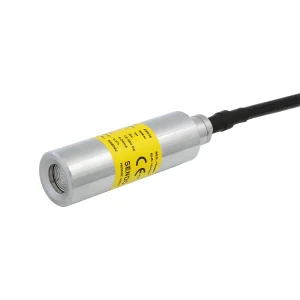
Maximum pressure measurement depth depends on several factors, including pressure ratings and many more discussed below.
Pressure Rating
Pressure rating is a key factor to consider when determining how deep you can install your pressure sensors.
Higher pressure ratings mean you can install very deep. However, lower pressure ratings mean you can install less deeply. If you accidentally install the lower pressure ratings deeper, it will result in permanent sensor damage.
| Pressure Rating | Maximum Freshwater Depth |
| 50 kPa | 5 m |
| 100 kPa | 10 m |
| 200 kPa | 20 m |
| 500 kPa | 50 m |
| 1000 kPa | 100 m |
| 2000 kPa | 200 m |
| 5000 kPa | 500 m |
Liquid Density
Liquid density varies from one liquid type to another. A denser liquid causes more pressure at the same depth on the pressure sensors. Therefore, you should first determine the liquid in which you are installing the pressure sensors and then measure the depth.
Buy pressure sensors that are compatible with the required liquid and offer accurate pressure measurements at the given depth and density.
| Жидкость | Relative Density |
| Fresh water | 1 |
| Sea water | 1.03 |
| Diesel fuel | 0.84 |
| Hydraulic oil | 0.87 |
| Heavy oil | 0.95 |
| Brine | 1.2 |
Cable Strength
Cable strength is also crucial for the in-depth pressure measurements. As you install your pressure sensors, you should always use compatible, durable cables.
At deeper lengths, the cables should have:
- High tensile strength
- Waterproof construction
- Vent tubes
- UV resistance
- Chemical resistance
Sensor Housing Materials
Sensor housing materials should be durable because of the following stress cases.
- High pressure as you install the sensors deeper.
- Harsh environmental conditions
Therefore, you should choose high-quality sensor housing materials. Here are a few examples of materials.
- Нержавеющая сталь 304
- Нержавеющая сталь 316L
- Титан
- Hastelloy
- Duplex stainless steel
Требования к точности
Accuracy of pressure measurements is more crucial than other factors. Since high liquid pressure can compromise accuracy, you should choose sensors that deliver accurate pressure readings.
| Точность | Suitable Applications |
| ±0.5% FS | General water tanks |
| ±0.25% FS | Industrial processes |
| ±0.1% FS | Municipal monitoring |
| ±0.05% FS | Laboratory systems |
| ±0.025% FS | Scientific research |
Can a Submersible Pressure Transmitter Measure More Than 500 Meters?
It is not certain that pressure sensors will reach a specific depth. A few pressure sensors can exceed 500 meters of depth.
A few models of pressure sensors can reach:
- 500 meters
- 750 meters
- 1000 meters
- 1500 meters
- Even deeper in custom scientific applications.
Such pressure sensors are ideal for the following applications.
- Offshore drilling
- Oceanographic research
- Deep reservoirs
- Underwater robotics
- Hydroelectric dams
| Sensor Pressure Range | Approximate Water Depth | Typical Applications |
| 0–1 m | Small tanks | Laboratory equipment |
| 0–2 m | Открытые резервуары | Chemical processes |
| 0–5 m | Irrigation tanks | Water storage |
| 0–10 m | Groundwater | Pump stations |
| 0–20 m | Reservoirs | Municipal water |
| 0–50 m | Boreholes | Deep wells |
| 0–100 m | Industrial wells | Добыча |
| 0–200 m | Deep groundwater | Water supply |
| 0–300 m | Oilfield water | Large reservoirs |
| 0–500 m | Offshore applications | Specialized industries |
| 500–1000+ m | Scientific research | Deep marine monitoring |
Choosing the Right Measurement Range of Submersible Pressure Sensors
When choosing the right measurement range of submersible pressure sensors, you should look at the several factors discussed below.
Determine the Maximum Liquid Depth
What is your maximum liquid depth where you want to measure the pressure? If your required depth is 10 meters, you don’t buy a pressure sensor with a 10m length. Instead, go for a higher length so you can measure accurate values.
Here are a few tips.
- Measure the maximum liquid depth.
- Add a 10–20% safety margin.
- Consider future level increases.
- Avoid oversized pressure ranges.
| Maximum Depth | Recommended Sensor Range |
| 4 m | 5 m |
| 8 m | 10 m |
| 18 m | 20 m |
| 45 m | 50 m |
| 90 m | 100 m |
Consider the Liquid Type
Different liquid types have different densities. Choose a pressure sensor compatible with the required liquid types.
Here are a few tips to choose.
- Calibrate for the actual liquid.
- Water is the standard reference.
- Denser liquids create higher pressure.
- Oils create lower pressure.
| Жидкость | Relative Density |
| Fresh Water | 1 |
| Sea Water | 1.03 |
| Diesel | 0.84 |
| Hydraulic Oil | 0.87 |
| Brine | 1.2 |
Select the Appropriate Pressure Range
Using the correct pressure range helps measure the pressure values accurately. Don’t go for oversized or undersized sensors and follow the tips below.
- Choose the closest suitable range.
- Avoid undersized sensors.
- Don’t oversize unnecessarily.
- Check overload capacity.
Match the Installation Environment
The installation environment varies. You should choose a pressure sensor that has all those features compatible with the given conditions. Here are a few tips to choose.
- Choose suitable housing material.
- Use the correct cable length.
- Consider corrosion resistance.
- Check temperature ratings
| Application | Recommended Feature |
| Water Tank | Stainless steel housing |
| Deep Well | Reinforced long cable |
| Сточные воды | Нержавеющая сталь 316L |
| Seawater | Titanium housing |
| Chemical Tank | Corrosion-resistant materials |
Заключение
A few marine applications require pressure sensors to measure at greater depths. However, there are a few pressure sensors that can be submerged and measure the pressure values. For example, Standard models commonly measure up to 200 meters. It is suitable for tanks, wells, reservoirs, and groundwater systems. Specialized industrial and scientific transmitters measure pressures at a depth of 500 meters, 1,000 meters, or even more.
Are you looking for high-quality pressure sensor solutions for different environmental conditions and applications? Contact Сендо-сенсор and explore a wide range of pressure sensors. We assess, measure, and ensure the values are correct. Check out our pressure solutions right away!