

How HVAC pressure transducers help achieve modern SEER/EER compliance? It’s a hot topic these days. As you know, electricity prices are rising steadily. That’s why energy efficiency has become a top priority in modern HVAC systems. That’s why efficiency standards like SEER and EER are crucial in modern HVAC design.
One important factor that directly affects HVAC efficiency is pressure control. Even small pressure changes inside an HVAC system can increase energy consumption. To avoid this, modern HVAC systems rely on pressure transducers. In this article, I will discuss how these pressure transducers help achieve SEER and EER compliance in the simplest way possible. So let’s get started!
What Are SEER and EER?
Before we dive into the details, let’s discuss what exactly SEER and EER are.
SEER stands for Seasonal Energy Efficiency Ratio. It is a rating that shows how energy-efficient an HVAC system is over an entire season. In simple terms, it tells you how much cooling an HVAC system provides compared to how much electricity it uses.
Remember, the SEER rating is directly proportional to energy efficiency. A higher SEER rating means an HVAC system is more energy efficient. That’s why governments set minimum SEER requirements for new HVAC systems. If a system’s SEER rating is below this minimum, it cannot be sold or installed.
EER stands for Energy Efficiency Ratio. It measures efficiency at one specific condition, usually during very hot weather when the system is working hard. In other words, EER shows how well an HVAC system performs at peak load while using less energy.
Like SEER, the EER rating is also directly proportional to the energy efficiency of an HVAC system. An HVAC system with a higher EER rating will work more efficiently, especially under heavy loads. Moreover, a good EER rating also indicates that the HVAC system consumes less power and remains energy efficient.
What is an HVAC Pressure Transducer & How Does it Work?

Before we explain how HVAC pressure transducers help achieve modern EER and SEER, let’s first understand what they are.
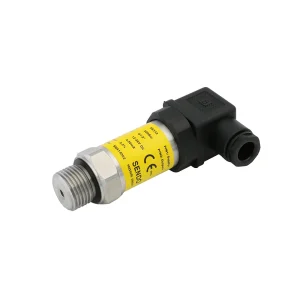
An HVAC pressure transducer is a small sensor used in heating and cooling systems. It helps measure pressure inside the system. This sensor measures air or refrigerant pressure and sends the information to the HVAC control unit. Simply put, it enables the system to know whether the pressure is too high, too low, or just right.
The working principle of an HVAC pressure transducer is very simple. It works by sensing pressure changes and turning them into an electrical signal. When the pressure changes, the sensor, like a 4-20 mA pressure sensor SS20 inside the pressure transducer, detects them. After that, the pressure transducer converts this pressure into an electrical signal.
The HVAC controller receives the signal from the pressure transducer. It understands exactly how much pressure is inside the system at that moment. If the pressure is too low or too high, the HVAC system automatically adjusts. For example, it can speed up or slow down the compressor, open or close valves, or adjust airflow.
All this is done to ensure the HVAC system operates efficiently at all times. Remember, this process continues all the time while the HVAC system is running. The pressure transducer continuously checks the pressure and sends updates. As a result, the system reacts instantly to changes and operates efficiently without consuming more energy.
HVAC 압력 변환기가 현대적인 SEER/EER 규정 준수를 어떻게 돕는가?
Now you understand the basics of a pressure transducer and how it works. Right? So let’s discuss how this device helps HVAC systems run efficiently and meet modern energy standards (SEER & EER).
1- Maintain Accurate Pressure Control
In an HVAC system, the correct pressure level is critical. Why? If the pressure is too high, it will increase the compressor’s workload. Overworking the compressor means higher energy consumption. However, too low pressure can reduce cooling and make the HVAC system struggle. That’s where HVAC pressure transducers help maintain pressure and achieve SEER/EER compliance.
They continuously monitor the pressure in real time and send signals to the HVAC controller. The controller uses these signals to automatically adjust the system. This means the system reacts quickly to pressure fluctuations. As a result, your HVAC system operates efficiently without consuming much energy (in compliance with SEER/EER).
2- Improve Compressor Efficiency
The compressor is one of the most essential parts of an HVAC system. It pumps refrigerant through the system and helps produce cooling. As you can see, this system works hard, so it consumes much more electricity than all other components. If the compressor works too much or under the wrong pressure, the HVAC system becomes inefficient.
As a result, it will consume more energy than usual, which will affect the SEER/EER rating. However, HVAC pressure transducers maintain compressor efficiency. How? As I said above, they constantly monitor the system’s pressure and provide data to the HVAC controller. In the event of any pressure change, the controller can adjust the compressor’s speed or operation.
For example, if less cooling is needed, the compressor can slow down rather than run continuously at full speed. This reduces the compressor’s workload, thereby lowering energy consumption. It directly helps the HVAC system achieve a higher SEER/EER rating.
3- Support Variable-Speed HVAC Systems
Modern HVAC systems now use variable-speed compressors and fans. It means they can adjust their speed according to the cooling or heating demand. Unlike old HVAC systems, variable-speed systems can run slowly when less cooling or heating is needed. This reduces energy consumption (improves SEER/EER rating).
However, pressure transducers are essential for these variable-speed HVAC systems. They continuously measure the pressure inside the system and send signals to the controller. The controller then decides how fast the compressor or fans should run to maintain optimal pressure.
Let’s suppose that pressure drops below the optimal level. In this case, the system may increase the compressor speed. All this ensures that the HVAC system does not waste energy by running at full speed unnecessarily. In this way, HVAC pressure transducers help achieve modern SEER/EER compliance.
4- Control Refrigerant Flow
First, you should know what a refrigerant is. Basically, a refrigerant is a fluid that carries heat in an HVAC system. Its flow rate matters a lot for efficient cooling and heating. How? If the refrigerant flow is too high or too low, the system cannot transfer heat efficiently. This increases energy waste and reduces HVAC system performance.
But the pressure transducer measures the refrigerant pressure at different points. After that, it sends signals to the controller to maintain the refrigerant flow rate. The correct refrigerant flow means HVAC systems work efficiently without consuming much energy. This directly helps the HVAC system achieve a high SEER/EER rating.
5- Improves Peak Load Performance
You will agree with me that in extreme winters and summers, HVAC systems work under high load. They need to provide maximum heat or cooling, which increases their workload. These are the times when energy efficiency is most important but also most challenging to maintain. That’s where HVAC pressure transducers come into play.
Pressure transducers help the system respond to these demanding conditions. They detect pressure changes, and the system adjusts its components to reduce excess energy usage. All this ensures that even in peak load, an HVAC system works efficiently and achieves a high SEER/EER rating.
6- Fault Prevention of HVAC Systems
HVAC systems can develop faults such as refrigerant leaks or compressor malfunctions. If these faults are overlooked, they can reduce HVAC system efficiency. This means the system needs to work harder, which consumes more energy. That’s why detecting these faults earlier is crucial to achieving a higher SEER/EER rating.
For this, 산업용 압력 트랜스미터 serve as early warning systems. They continuously monitor the pressure changes and detect abnormal conditions. If there is a fault anywhere in the system, the pressure transducer alerts the controller. This helps maintain energy efficiency and ensures that the HVAC system continues to meet SEER and EER standards over time.
결론
Let’s conclude: HVAC pressure transducers may look like small devices. However, they play a significant role in maintaining the energy efficiency of an HVAC system. This higher energy efficiency results in higher SEER and EER ratings for the HVAC system. In this article, I have discussed in detail how an HVAC pressure transducer helps achieve modern SEER and EER compliance. For example, it continuously detects the pressure changes in the system.
If there is a rise or fall in pressure, the pressure transducer’s sensor immediately detects it. After that, it sends signals to the HVAC system controller. The controller adjusts the compressor, airflow, etc., to meet the system’s demands. In this way, an HVAC pressure transducer ensures that all components operate effectively without consuming excess energy. So, pressure transducers are essential for both energy savings and legal compliance in modern HVAC systems.